

 Sansar News



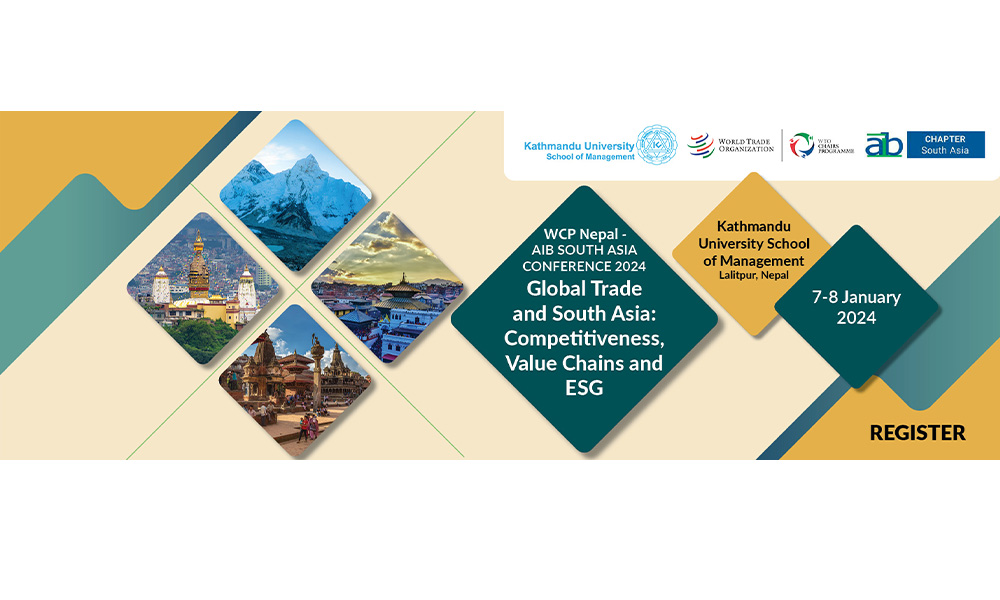
Kathmandu: The WCP Nepal-AIB South Asia Conference, 2024, a collaborative effort by the World Trade Organization (WTO) Chairs Programme Nepal and Kathmandu University, has officially commenced in Kathmandu for a two-day duration. The conference, themed ‘Global Trade and South Asia: Competitiveness, Value Chains, and ESG’, aims to address crucial issues related to global trade dynamics.
During the event, Professor Achyut Wagle, Registrar of Kathmandu University, emphasized the importance of Nepal adopting a specific commerce policy, especially as the country transitions to a middle-income status. He recommended the promotion of good production and the development of forward and backward linkages to enhance global market competitiveness.
Professor S. Raghunath, the AIB-SAC Executive Board Chair, stressed the necessity of formulating advanced foreign trade policies to ensure an efficient supply chain. He highlighted the global interdependency for seamless supply chains and urged equal participation and contribution to the supply chain, emphasizing the utilization of innovations and intellectual rights to boost locally produced products.
Narayan Prasad Sharma Duwadee, Secretary at the Ministry of Industry, Commerce, and Supplies, pledged to consider and implement research-based suggestions to address policy-level gaps in foreign trade. He emphasized the need for diverse expertise in crafting effective policies, particularly as Nepal manages challenges associated with its transition to a developing country.
Ambassador Ram Prasad Subedi, Permanent Mission to the UN, described foreign trade as a driver of development and prosperity. He emphasized the significant role South Asia plays in the global market, advocating for product and market diversification to tackle Nepal’s high trade deficit.
Ambassador Subedi highlighted ongoing discussions at the United Nations regarding the continuation of duty-free and quota-free facilities for Nepal and Bangladesh, even after their graduation to developing country status. He stressed the importance of timely changes to Nepal’s commerce policy.
Xiangchen Zhang, WTO Deputy Director-General, mentioned ongoing capacity-building efforts to facilitate global trade. He committed to initiatives for continuing trade facilities with the least developed countries and emphasized the international community’s responsibility to address climate change and environmental risks.
Dr. Bhola Thapa, Vice-Chancellor of Kathmandu University, highlighted the changing trade dimensions affecting small economies like Nepal, calling for collaborative efforts to address these challenges. He expressed optimism that research and discussions at the conference would contribute to better policy-making.
Professor K Rangarajan from the Indian Institute of Foreign Trade, Kolkata Campus, noted that despite a high demographic dividend, South Asia has not fully benefited from the trade sector. He urged the region to explore innovative technologies for global market access.
Dr. Pankaj Mittal, General Secretary of the Association of Indian Universities, suggested that academic studies could help maintain inter-country linkages. Over 60 experts, researchers, and academicians from seven countries are participating in the conference, presenting and discussing research papers on various topics over the two-day event.
वि.सं.२०८० पुस २२ आइतवार १६:४२ मा प्रकाशित